A new study published in Oryx takes a rare, data-focused look at how environmental crime appears within one of the world’s main international enforcement tools: Interpol Red Notices.
Interpol Red Notices are alerts issued by member countries to seek help in locating and arresting individuals wanted for crimes. They have played a role in some successful environmental cases, such as tracking down suspects linked to ivory smuggling and the illegal turtle trade, proving that the tool can be useful for fighting cross-border environmental crime.
Still, the study finds that Red Notices are used only sparingly for environmental offences.
A clear lack of representation
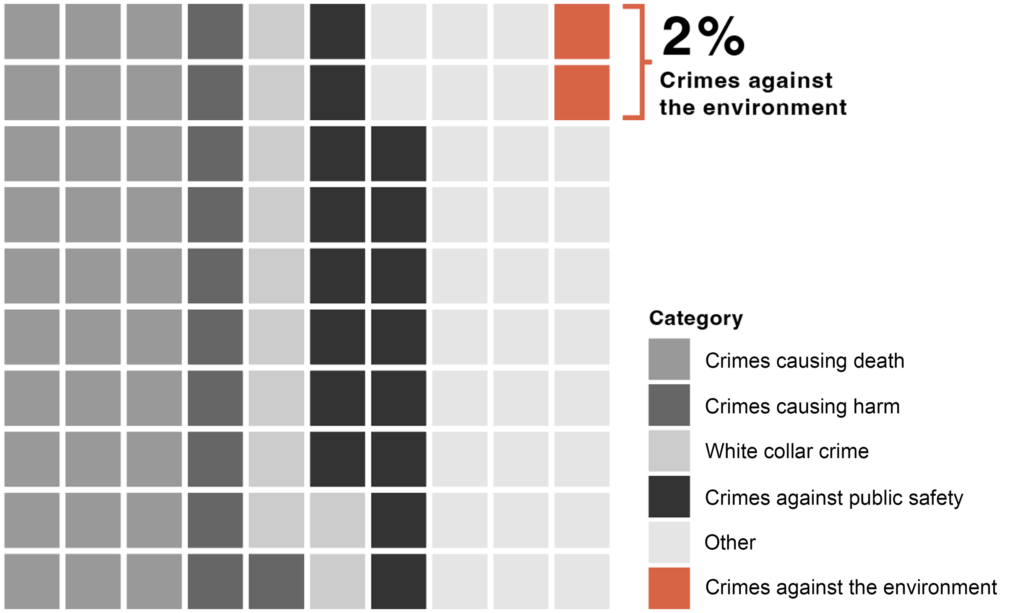
The researchers analysed 4,464 Red Notices, taken from a pool of 7,010 active Notices as of December 2023. Out of those, only 21 were classified as related to environmental crime, using the UN’s International Classification of Crime for Statistical Purposes.
That accounts for only 2%, which makes environmental crime the least represented among major crime categories. To compare, white-collar crime made up 11% of the Notices in the sample.
Only 72 of Interpol’s 196 member countries had issued at least four Red Notices related to environmental crime, showing that this tool remains underused across most of Interpol’s network.
Source: https://www.cambridge.org/core/journals/oryx/article/environmental-crimes-are-overlooked-in-global-enforcement-an-analysis-of-interpol-red-notices/B0233AB0E20F19DA92442BD3AB097E63#article
What types of crimes were included?
Among the 21 Red Notices linked to environmental crime, the most common themes were:
- Wildlife trade
- Timber extraction
While environmental crime includes a wide range of offences, the study found no Notices related to transnational illegal marine extraction or habitat degradation, which suggests certain crime types may be overlooked or underreported and could benefit from further investigation.
Enforcement patterns and sentencing issues
The study also places its findings within a broader context of enforcement challenges. Previous research cited by the authors shows that:
- Environmental offences often receive more lenient sentences compared to other crimes.
- Many regions struggle with low resources, low detection rates, and low conviction rates.
Combined with the underuse of Red Notices, these issues point to broader weaknesses in how environmental crimes are pursued and punished.
A gap between stated priorities and real-world action
Organisations like Interpol have repeatedly called environmental crime a global priority. Its Environmental Security Strategic Plan includes goals around increasing the use of Notices, and its Global Wildlife Enforcement team emphasises the need for better data sharing.
Despite these commitments, the study highlights a clear gap between what has been promised and how often Red Notices are actually used to pursue environmental offenders.
For example, the researchers found no environmental Red Notices from countries like Italy and France despite known levels of environmental crime there. This raises questions about how individual countries approach enforcement, and whether their systems are aligned with global priorities.
Legal Momentum vs. Enforcement Reality
Recent international developments, like the UN General Assembly’s recognition of the right to a clean, healthy and sustainable environment, may help push enforcement forward. The growing use of rights of nature laws in national legal systems in at least 29 countries is another sign of progress.
But the study warns that even strong legal frameworks don’t guarantee enforcement. If tools like Red Notices continue to be underused, it will be hard to turn legal recognition into real-world impact.
The authors stress the need to understand why Red Notices are so rarely used in this space, whether due to legal restrictions, poor communicatio, or coordination issues between agencies.
A critical moment for global enforcement
The study argues that the very limited use of Interpol Red Notices for environmental crime signals a potential weakness in global enforcement efforts. Closing this gap will be essential if the international community hopes to meet its environmental crime priorities.
Better use of existing tools and a clearer understanding of why they are not being fully used could significantly strengthen national and international efforts to hold environmental offenders accountable.
There are several initiatives working to build capacity and strengthen enforcement efforts, including our own WildLIFE Crime Academy. The current phase (2024–2029) aims to work in 15 countries across Europe, North Africa and the Caucasus. Our goal is to directly train 100 professionals from law enforcement, forensic and conservation backgrounds, who will then train an additional 1,000 people through national training programmes.