24 vultures were found poisoned and decapitated in Senegal. This is the third large poisoning incident in Africa since the beginning of the year. The incident seems to be part of traditional rituals.
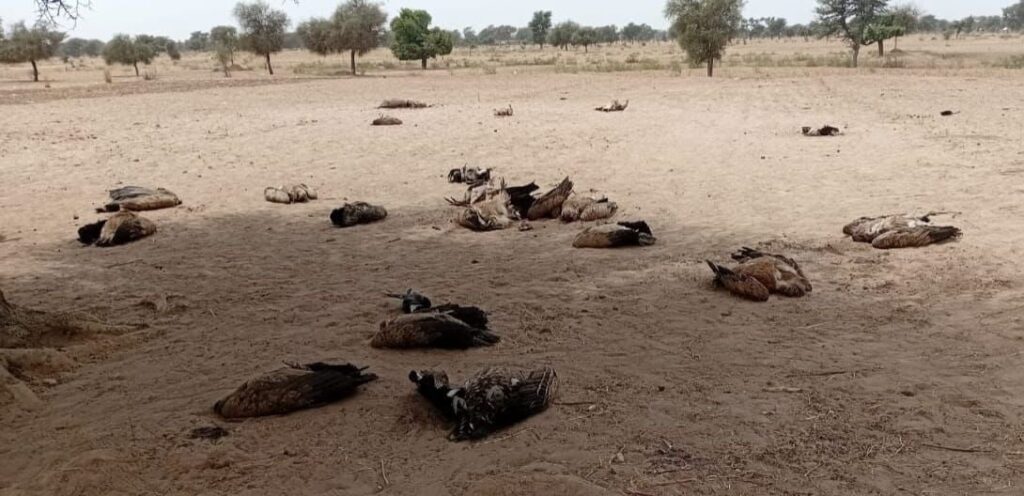
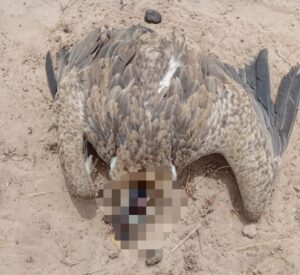
On March 8, the Mbour Gendarmerie Company was alerted to the presence of a dead donkey surrounded by several lifeless vultures on the outskirts of the village of Khaoul Godaguène. According to the initial investigation, the donkey belonged to a local farmer and showed signs of sickness several days before the macabre discovery. The farmer declared that when he was alerted to the death of his animal, the carcass had already attracted numerous vultures. The same vultures that the local police found dead and beheaded a couple of days later. Sadly, one of the retrieved vultures was a marked individual, showing two leg rings. The tagging institution has not been identified yet. The local authorities are investigating the case.
The scene suggests a case of ritual poisoning and killing, a cruel practice popular in some areas of the African Continent. Some people believe that using vultures’ head in traditional rituals could bring them good luck. These practices become exponentially more frequent in moments of high social pressure, such as political elections or popular football matches. These cultural practices often fuel an underground market that kills hundreds of animals every year, vultures included.
A grim beginning of the year
This is the third known large poisoning incident in Africa since the beginning of the year. In January, thirty-four vultures were killed in the Amboseli National Park at the Kenya-Tanzania border, and twenty-two were poisoned in Burkina Faso. The first case was the result of human-wildlife conflict, where vultures were unintended victims of a poisoned carcass placed to kill lions. The second case, on the other hand, deliberately targeted vultures to sell their bodies on the black market.
Last summer, a series of poisoning incidents motivated by traditional beliefs resulted in the deaths of nearly one hundred Critically Endangered (IUCN) Hooded Vultures (Necrosyrtes monachus) in The Gambia. The event triggered a national and international response, resulting in a mission led by the CMS Raptors MOU, Vulture Conservation Foundation (VCF), and Birdlife International to strengthen capacity among key stakeholder groups, including government agencies, to prevent and respond to illegal wildlife poisoning incidents.
A far-reaching threat
Vultures play a crucial role in the ecology. By consuming carcasses, they control the spread of harmful pathogens and the numbers of facultative scavenger populations, which can be responsible for spreading deadly diseases like rabies. The decline of these scavengers undermines one of nature’s most effective mechanisms for disease control.
Mass poisoning events have far-reaching impacts on local ecosystems, with serious consequences for both human and wildlife health, as well as for already threatened vulture populations.