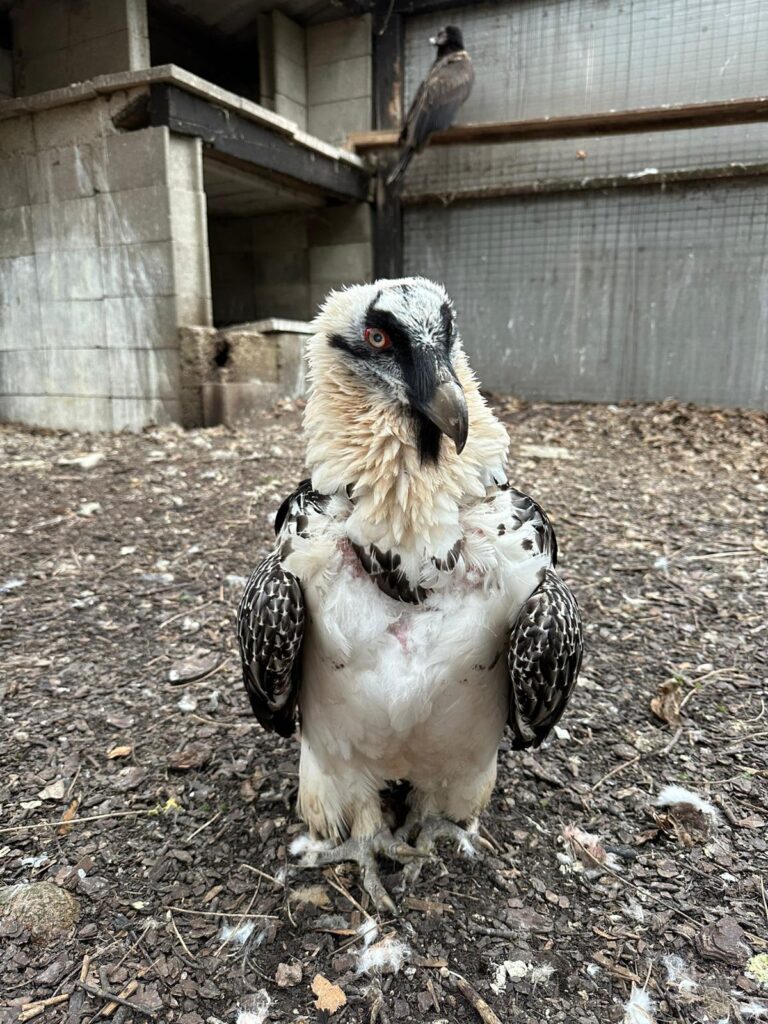
Most Bearded Vultures in the Captive Breeding Network live for 30-40 years. BG006 has outlasted almost all of them. She hatched at Alpenzoo Innsbruck on 13 February 1978, and this year, she turned 48, the oldest female Bearded Vulture currently alive in the programme. We have never had a female Bearded Vulture quite like her.
Where she came from
Her parents were the first pair to breed within the Bearded Vulture Captive Breeding Programme. That alone would be enough to make her lineage remarkable. But the story of how they got there is something else entirely.
Her parents’ line traces back to the Kopetdag mountains in Turkmenistan. The birds were kept in Zoo Dresden before being transferred to Alpenzoo Innsbruck in 1973. Moving a protected raptor species across borders is complicated enough today, with the paperwork, permits, and coordination involved. In 1973, it’s almost impossible to imagine how it was managed. But it was.
BG006 hatched five years later, a direct product of that unlikely chain of events.
A life in motion
She didn’t stay in Alpenzoo Innsbruck long. In the same year she hatched, she was transferred to Richard Faust Specialised Bearded Vulture Breeding Centre (RFZ) in Austria. From 1979 to 1990, she lived at Wildpark Cumberland Grünau, then returned to RFZ, where she has remained ever since.
Over the decades, she was paired with eight different males. With five of them, she bred successfully. Between 1985 and 2023, she laid 51 eggs, hatched 23 chicks, and 18 survived. On top of that, she raised more than 20 chicks as a foster parent. These aren’t just numbers; each of those birds went on to carry the genetics that originate from the mountains of Central Asia.
Famous offspring
She has many descendants across Europe, but two of them have quite a story to their name.
Tono was released in Andalusia, Spain. In 2015, alongside his partner Blimunda, he became the first captive-bred Bearded Vulture to breed successfully in the wild in southern Spain, a landmark moment for the reintroduction effort there. He is still active in the wild.
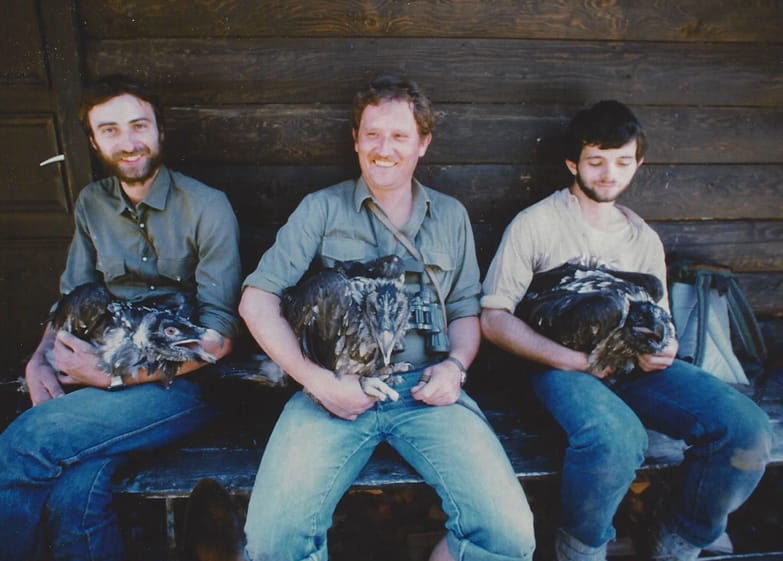
Winnie had a harder story. She was one of the first Bearded Vultures released in the Alps as part of the reintroduction programme. She was released in 1986 in Nationalpark Hohe Tauern, Austria, but she had to be recaptured the following year. She was found in an alpine river with her feathers frozen. She spent the rest of her life within the breeding network across Austria, France, and Switzerland, contributing to the programme in a different but still meaningful way. She was euthanised in 2023 at RFZ due to declining health.
The foster years
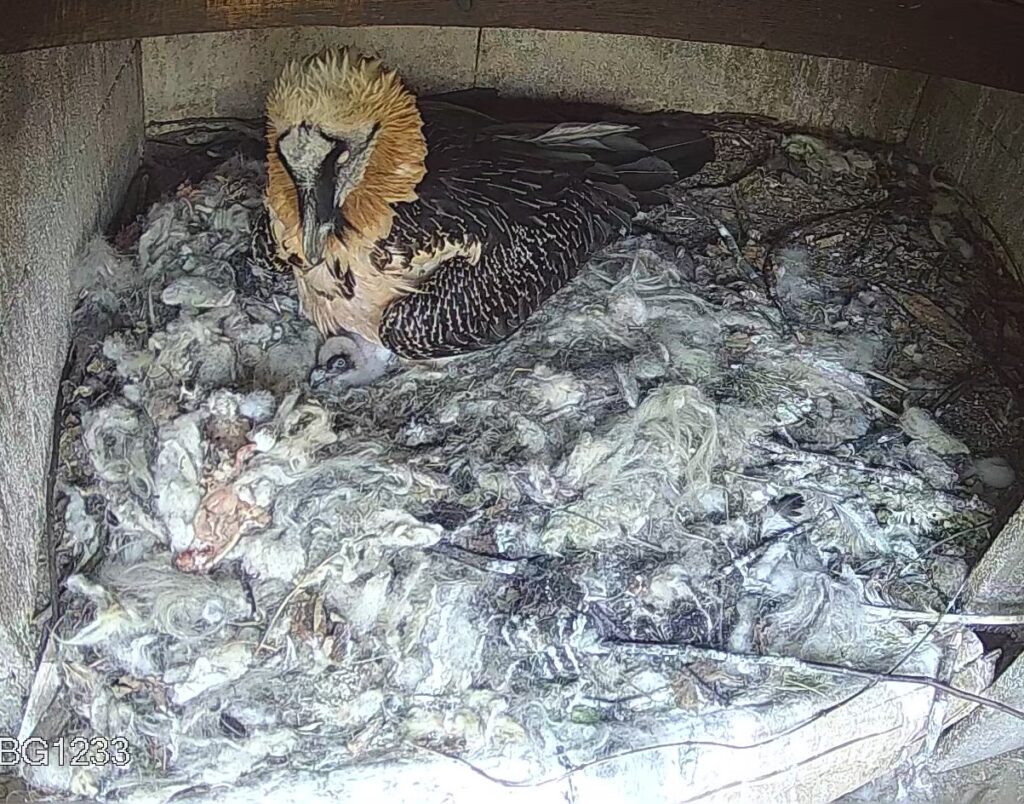
Since 2008, BG006’s main role has been as a foster parent. This is not a secondary function; it is one of the most critical roles in the entire network. In the wild, Bearded Vultures can hatch two chicks, but only one survives due to ‘cainism,’ where the first-hatched chick attacks and kills its younger sibling. In captivity, we try to save both chicks, and this sometimes means that one of the chicks needs to be adopted and raised by foster parents, although double and even triple adoptions at the same time happen in some cases. It’s important for Bearded Vultures to raise chicks to ensure the chick grows up to behave like a wild bird and can therefore be part of reintroduction programmes and breed in the future.
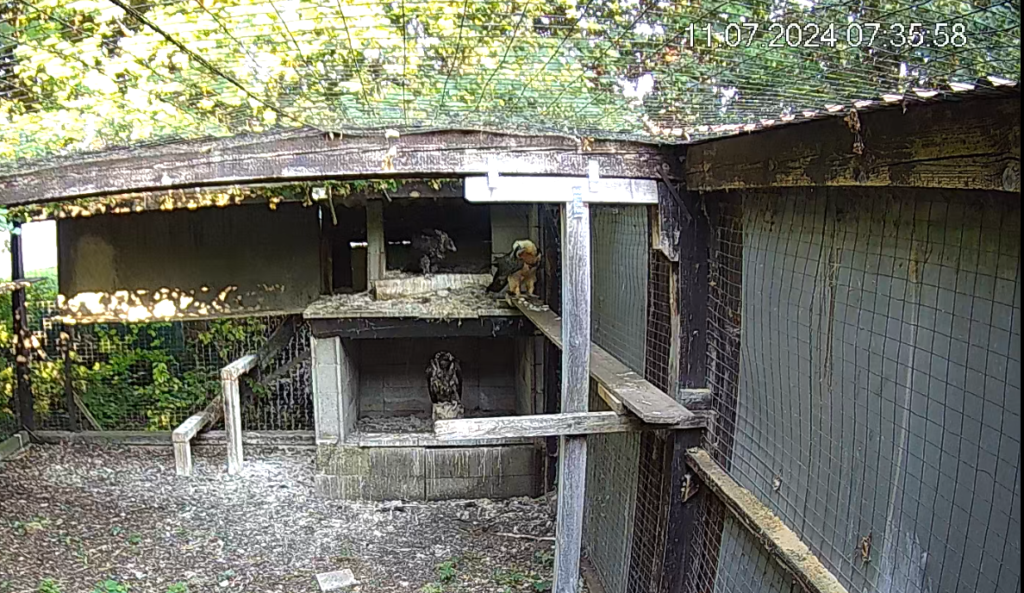
Adoption is never straightforward. Placing a chick with an adult bird carries risk, and that risk increases with the age of the chick. A young bird placed with a large, unfamiliar adult may panic, defend itself, and trigger an aggressive response. The older and bigger the chick, the more fraught the introduction can become.
BG006 has shown, repeatedly, that experience changes everything.
In 2024, she adopted three chicks, including two brought in from other zoos. BG1252 arrived from Pairi Daiza in Belgium at two months old. BG1246 came from Tallinn Zoo in Estonia at over 70 days, an age at which chicks know how to hold their ground. An adult bird that reacts badly to a frightened, pecking chick can cause serious harm. BG006 didn’t. She absorbed whatever the chicks threw at her and gave them what they needed: food, steadiness, and time. All three came through without incident.
Over the years, she has also guided inexperienced males through the process of mating, a form of knowledge transfer that can’t be replicated by any other means. It simply has to be lived and learned.
The egg nobody expected
By 2023, the team at RFZ had drawn a quiet conclusion: BG006 had laid her last egg in 2022, infertile and small, and had not laid in 2023. It seemed a natural end to that chapter. She was in her late forties. They began to think of retirement.
Then, on 3 February 2024, she laid another egg.
It had never been recorded before, a Bearded Vulture of her age, after skipping a season, laying again. The team described it simply as a sensation. Whatever the biology behind it, the fact of it landed as a reminder of how much these birds can still surprise you after decades of observation.
2024 was her final year of adoption. She made the most of it.
Now
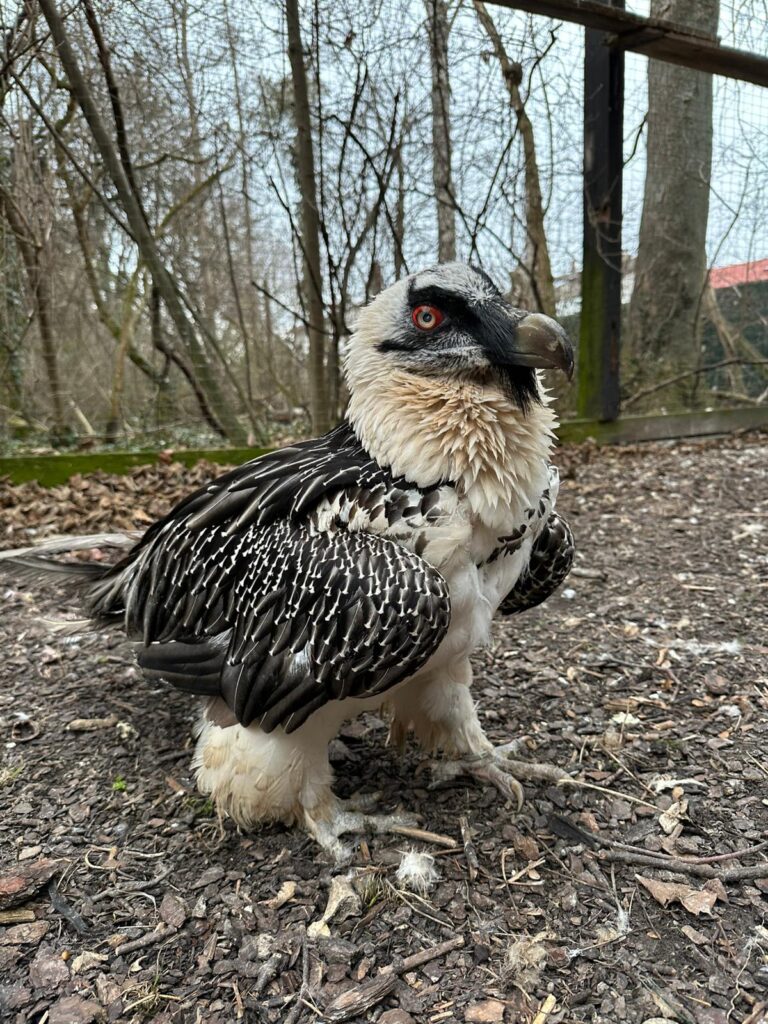
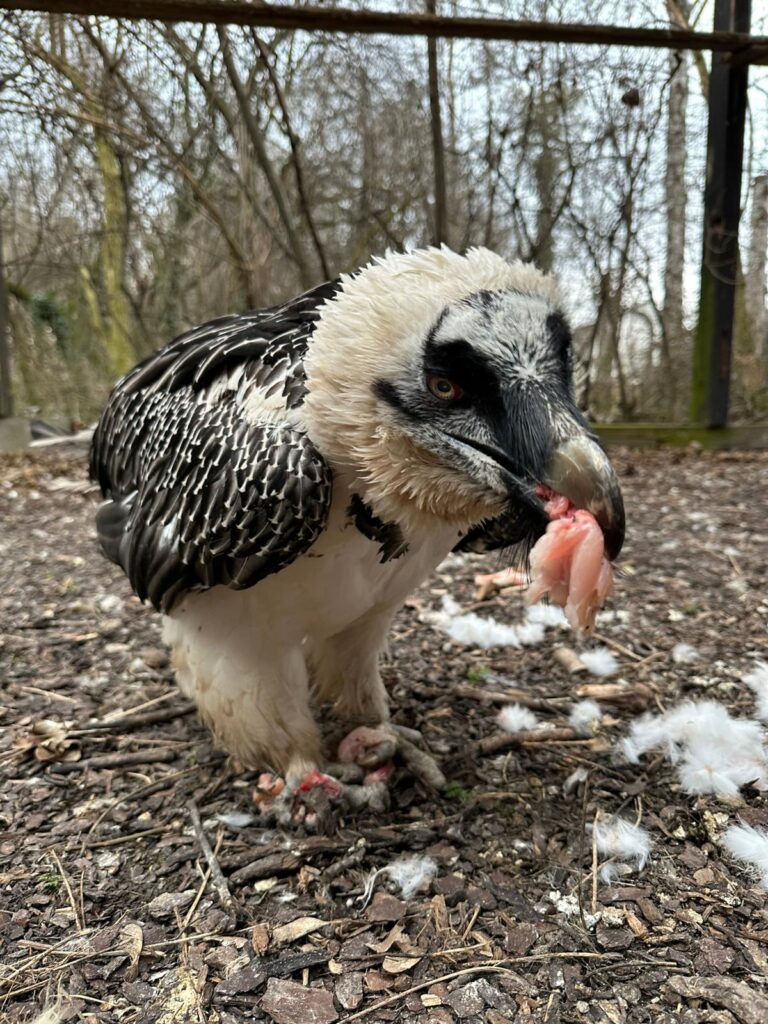
BG006 is blind in both eyes. She moves around the aviary regardless. She knows where the feeding station is, where the water bowl sits, and where the covered spots are when it rains. Years of living in that space have become a kind of internal map.
She can no longer find food on her own, so she is hand-fed daily to make sure she gets enough. Her companion is a bird she raised herself two years ago, now keeping her company in turn. The team at RFZ looks after her every day.
Forty-eight years. Fifty-one eggs. More than forty chicks, biological and fostered. Two offspring whose names are known across the reintroduction community. A bloodline that began in the mountains of Turkmenistan and now flies free in Europe.
Happy birthday, BG006, the oldest female Bearded Vulture alive in our breeding programme, and one of the most important birds the programme has ever had.