La International Bearded Vulture Monitoring (IBM) network has published its Annual Report 2024, offering a comprehensive overview of the status, movements, and breeding performance of Bearded Vultures (Gypaetus Barbatus) across Europe. Coordinated by the Vulture Conservation Foundation (VCF), IBM plays a central role in tracking the recovery of Bearded Vulture and supporting evidence-based conservation at an international scale.
A growing international monitoring network
In 2024, the IBM network brought together 20 partner organisations and 6 associated organisations, covering the Alps, Corsica, the Massif Central, and reintroduction areas in Spain. Through harmonised standards, a shared database, and close collaboration between field teams, the IBM ensures that data collected across borders can be reliably compared and used for conservation decision-making.
More than 2,600 validated Bearded Vulture observations were recorded directly by IBM partners in seven countries, complemented by thousands of additional records imported from national ornithological platforms. Together, these data allowed the identification of 226 individual Bearded Vultures in 2024, providing an unprecedented picture of population structure and movements across Europe.
New release efforts strengthening population connectivity
A total of 24 Bearded Vultures were released at eight sites in 2024, spanning Germany, France, Switzerland, and Spain. These releases form part of long-term strategies to reinforce existing populations and reconnect historically fragmented regions, particularly between the Alps, the Massif Central, and southern Spain.
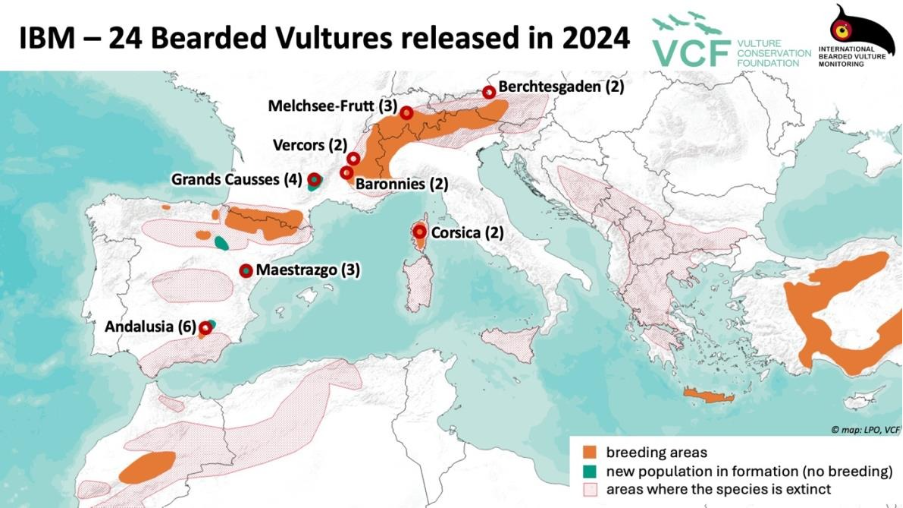
All released birds were equipped with solar-powered GPS transmitters, enabling detailed monitoring of dispersal, survival, and threats. In total, 97 Bearded Vultures—25 wild-hatched and 72 released birds—were tracked via GPS during the year.
Record-breaking breeding success in the Alps
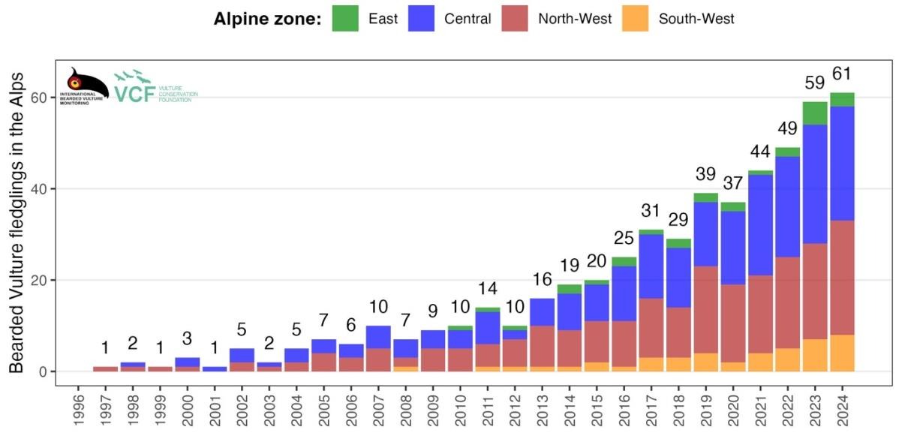
Within the Alpine range, 85 of the 94 territorial pairs/trios produced clutches, resulting in 72 hatched chicks (85% breeding success). A record-number of 61 young Bearded Vultures successfully fledged: 24 in Switzerland, 17 in France, 14 in Italy, and 6 in Austria.
Several territories celebrated important milestones, including first-ever breeding attempts and first successful fledging events in Switzerland, France, and Italy—clear signs that the population continues to expand into suitable habitat. While productivity varied between regions and years, the overall trend confirms the long-term success of coordinated reintroduction and protection efforts.
Mixed results in other areas
Beyond the Alps, the picture remains more complex. In Corsica, four territories were occupied and breeding was attempted, but no chick ultimately fledged for the fourth consecutive year. In contrast, the Massif Central saw further consolidation, with a second breeding territory established—an important step toward reconnecting Alpine and Pyrenean populations.
In Andalusia, breeding activity was recorded in nine out of twelve monitored territories, resulting in four fledged juveniles.
Reproduction status in 104 monitored territories in the Alpine range, Corsica and the Massif Central. In the Massif Central, a second breeding territory has been established, in addition to the male pair that has been present since 2018. Despite breeding attempts in four territories, no chick fledged on Corsica. The rectangles represent the 4 monitoring zones: south-western Alps, north-western Alps, central Alps and eastern Alps, from left to right.
Threats remain: the importance of monitoring
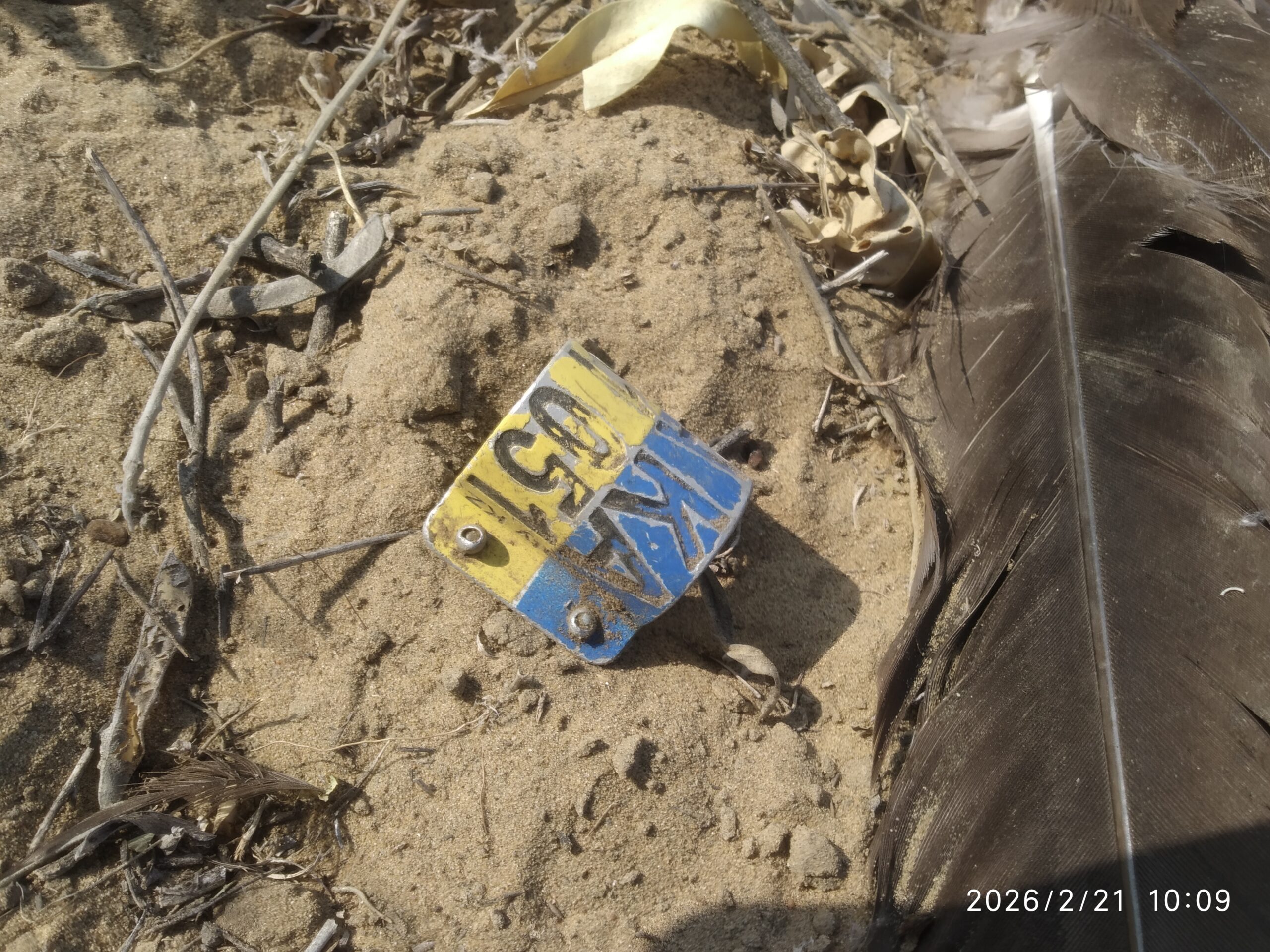
Despite these successes, the report also documents 15 dropout cases, including mortalities, recoveries, and one unsuccessful release. Alarmingly, anthropogenic causes accounted for at least one third of known mortalities, once again highlighting the ongoing risks posed by human activities. GPS tracking proved crucial in detecting incidents early and, in several cases, preventing further losses.
A cornerstone for European Bearded Vulture conservation
La IBM Annual Report 2024 highlights how long-term monitoring, international cooperation, and shared standards are essential for the recovery of wide-ranging species such as the Bearded Vulture. From record breeding success in the Alps to ongoing challenges in more isolated regions, the results offer both reasons for optimism and clear priorities for future action.
This report would not be possible without the dedication of field workers, assistants, gamekeepers, hunters, ornithologists, and non-professional observers who contribute sightings and reproduction data. We also thank the regional coordinators of the IBM network and associated organisations for managing data entry, coordinating monitoring efforts, and contributing their expertise. Special thanks go to Franziska Lörcher for her valuable input during the review process.
The publication of this report was made possible through the financial support of IBM partners and funding organisations, including MAVA Foundation, LIFE GypConnect, LIFE GypRescue, LIFE GypAct, and Bearded Vulture LIFE.
Read the full International Bearded Vulture Monitoring Annual Report 2024 to explore the data, maps, and detailed analyses behind these results.

La International Bearded Vulture Monitoring Network (IBM) is a unique international collaboration between national & natural parks and non-governmental organisations, coordinated by the Vulture Conservation Foundation (VCF), to monitor the population of the Bearded Vulture in Europe.
The IBM-network collects, shares and makes available Bearded Vulture data to everyone working for the species’ conservation. It also uses this data and discusses conservation strategies and priorities for this species worldwide. There are currently 23 partners and associated organisations part of the IBM-network.