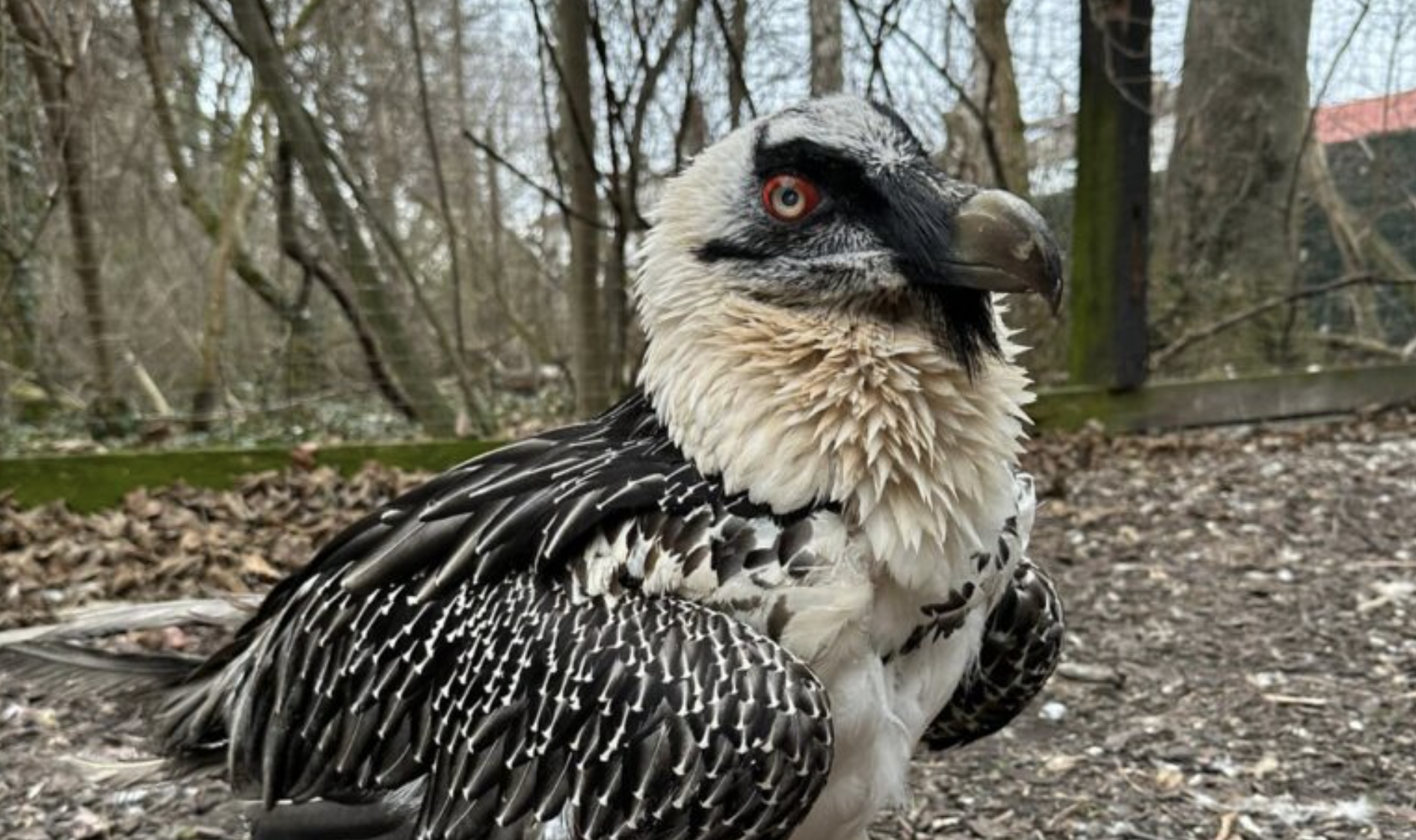
The year 2025 brought mixed results for the Bearded Vulture (Gypaetus barbatus) population in the Pyrenees, with some encouraging breeding outcomes in the French side of the mountains but continuing very poor breeding success on the Spanish side, while conservation efforts to reduce human-related threats are continuing.
The most recent report for the 2025 breeding season in the Pyrenees was published at “Circulaire Gypaète barbu dans les Pyrénées françaises – N°92 (2025)”, by LPO Aquitaine and its partners within the framework of the French National Action Plan for the Bearded Vulture.
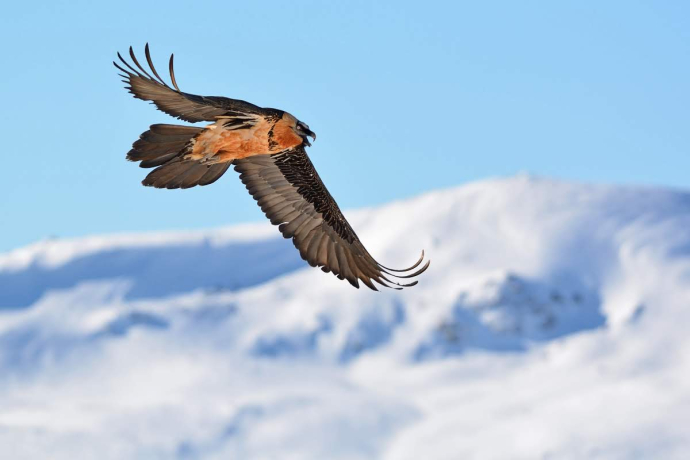
Bearded Vultures across the Pyrenees: an international perspective
Across the entire Pyrenean range (France, Spain and Andorra), only 50 young Bearded Vultures fledged in 2025 from 209 territorial units identified across the Pyrenean range.
There were a total of 151 territorial units in Spain (87 of which in Aragón, 51 in Catalonia and 13 in Navarra), 57 units in France and 1 in Andorra.
While France showed relatively strong breeding performance with a breeding success (number of fledged young divided by number of pairs who laid eggs) of 0,53, breeding output was much lower in all the Spanish regions, and no fledging was recorded in Navarre this year. The breeding success for Navarra was therefore nil, and only 0,34 for Aragón and 0,36 for Catalonia.
Breeding Summary from Pyrenees (France, Spain & Andorra) – Data from Circulaire Gypaète barbu dans les Pyrénées françaises – N°92 (2025)
| France | Navarre | Aragon | Catalonia | Andorra | Total | |
| Territorial pairs / trios | 57 | 13 | 87 | 51 | 1 | 209 |
| Clutches | 36 | 7 | 62 | 25 | 1 | 131 |
| Egg removals | – | – | 7 + 1* | – | – | 8 |
| Hatchings | 30 | 3 | 32 | 13 | 1 | 79 |
| Fledglings | 19 | 0 | 21 | 9 | 1 | 50 |
| Failures | 17 | 7 | 34 | 15 | 0 | 73 |
| Breeding success Fledglings / clutches | 0.53 | 0 | 0.34 | 0.36 | 1.00 | 0.38 |
| Productivity Fledglings / territories | 0.33 | 0 | 0.26** | 0.18 | 1.00 | 0.24 |
* One removed egg was not viable
** Includes the 7 removed eggs in productivity calculations
Overall productivity for the Pyrenean population (number of fledglings divided per number of territorial units) was only 0.24, a very low breeding output that suggests that the Pyrenees have long reached their carrying capacity.
Just for comparison, in the Alps in 2025 68 young fledged from 118 territorial pairs. In the Pyrenees, with almost double the number of breeding pairs (209), only 50 birds fledged.
Breeding results in the French Pyrenees
The breeding outputs in the French side of the Pyrenees were better than on the Spanish side with the overall breeding success (0,53) being above the average of the last ten years
The departments with the highest number of fledglings were Ariège with 7 fledglings and Hautes-Pyrénées with 5 fledglings.
Breeding Summary from French pyrenees – Data from Circulaire Gypaète barbu dans les Pyrénées françaises – N°92 (2025)
| Pyrénées-Atlantiques (64) | Hautes-Pyrénées (65) | Haute-Garonne (31) | Ariège (09) | Pyrénées-Orientales (66) | Aude (11) | Total | |
| Territorial pairs / trios | 16 | 15 | 5 | 12 | 7 | 2 | 57 |
| Clutches | 9 | 11 | 2 | 8 | 5 | 1 | 36 |
| Hatchings | 6 | 11 | 2 | 8 | 3 | 0 | 30 |
| Fledglings | 3 | 5 | 2 | 7 | 2 | 0 | 19 |
| Productivity Fledglings / territories | 0.19 | 0.33 | 0.40 | 0.58 | 0.29 | – | 0.33 |
| Breeding success Fledglings / clutches | 0.33 | 0.45 | 1.00 | 0.88 | 0.40 | – | 0.53 |
Some territories recorded remarkable successes, including the Sentein territory, where a chick fledged for the first time in 14 years, and Gavarnie, which continues to show consistently strong breeding parameters.
However, breeding failures were also frequent, often occurring during incubation or the first weeks of chick rearing. These failures highlight the continued vulnerability of the species to disturbance, weather conditions, and adult mortality.
Conservation actions: reducing human-related risks
Numerous conservation actions were carried out in 2025 in the French Pyrenees to reduce human-induced threats:
- Raising awareness among pilots:
Civil aviation pilots were trained in Béarn and at the French National School of Civil Aviation (ENAC) in Toulouse to reduce collision risks and disturbance in Bearded Vulture sensitive zones. Nearly 200 pilots were reached through these initiatives. Low flying small aeroplanes or helicopters are a significant source of disturbance and breeding failure.
- Power line safety:
An innovative experiment led by RTE (the transmission line utility) tested the installation of bird flight diverters (“firefly”) using drones in a high-risk area in Gavarnie-Gèdre. This method could allow for the installation of anti-collision devices on dangerous power lines while avoiding helicopter use.
- Outdoor sports management:
Temporary rerouting of mountain bike trails and the installation of new paragliding information panels helped limit disturbance near breeding sites, thanks to strong cooperation between conservationists, local authorities and sports federations.
Rescue and monitoring of individuals
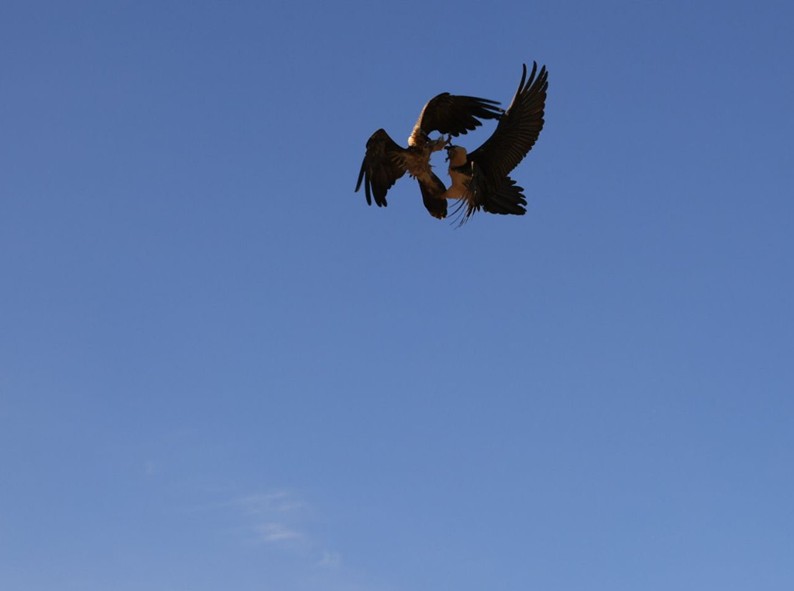
Several Bearded Vultures in distress were rescued in 2025 across the French Pyrenees. Notably, an adult found weakened in the Aspe Valley was treated and released with a GPS transmitter provided by the VCF. Named Etsaut, the bird has since ranged widely between the Basque Country, Navarre and Aragon, providing valuable data on movement ecology.
International Bearded Vulture Observation Days (IOD) in the Pyrenees
Each year, the second weekend of October is dedicated to the International Bearded Vulture Observation Days (IOD), co-organized by the International Bearded Vulture Monitoring Network (IBM), coordinated by VCF. The aim of this coordinated effort is to estimate the European population, locate territorial pairs and assess numbers at a regional scale. On 11 October 2025, under excellent weather conditions, 85 observers stationed at 40 observation points across the northern Pyrenees and Andorra took part in the count. A total of 97 Bearded Vulture observations were recorded during the day, corresponding to an estimated 47 different individuals.
Mortality in 2025
Unfortunately, four Bearded Vultures died in France in 2025, including Dôm and Rei del Causse and two adults that were found dead in the Hautes-Pyrénées. Judicial investigations are ongoing, and causes of death for these two still remain unknown. These losses remind us that adult survival remains a critical factor for the long-term viability of the population.


Looking ahead
The 2025 results show that the Bearded Vulture population in the Pyrenees remains stable, but that breeding continues to be very poor, especially on the Spanish side of the mountains.There are also a large number of non-breeding adults and immatures flying around. This suggests that the mountain chain has reached its maximum capacity, and that it would be beneficial to promote a wider and more effective dispersal from the core Pyrenean range to other mountain ranges, notably the Easternmost central system in Spain and the Alto Tajo area, across de Ebro valley, and the Cevennes in France, across the Aude valley, to help link several Bearded Vulture populations, and to alleviate pressure on breeding territorial units in the Pyrenees.
The VCF is working with both French and Spanish partners to discuss methods and actions that promote that wider dispersal from the Pyrenees, while continuing with the sustained efforts to reduce mortality, and safeguard breeding territories. Strengthening cross-border cooperation is essential to ensure safe a safe future for the species in the Pyrenees!
Source: https://www.lpo.fr/lpo-locales/la-lpo-en-nouvelle-aquitaine/lpo-aquitaine/actus-aquitaine/actus-2025-aquitaine/la-nouvelle-circulaire-gypaete-est-en-ligne